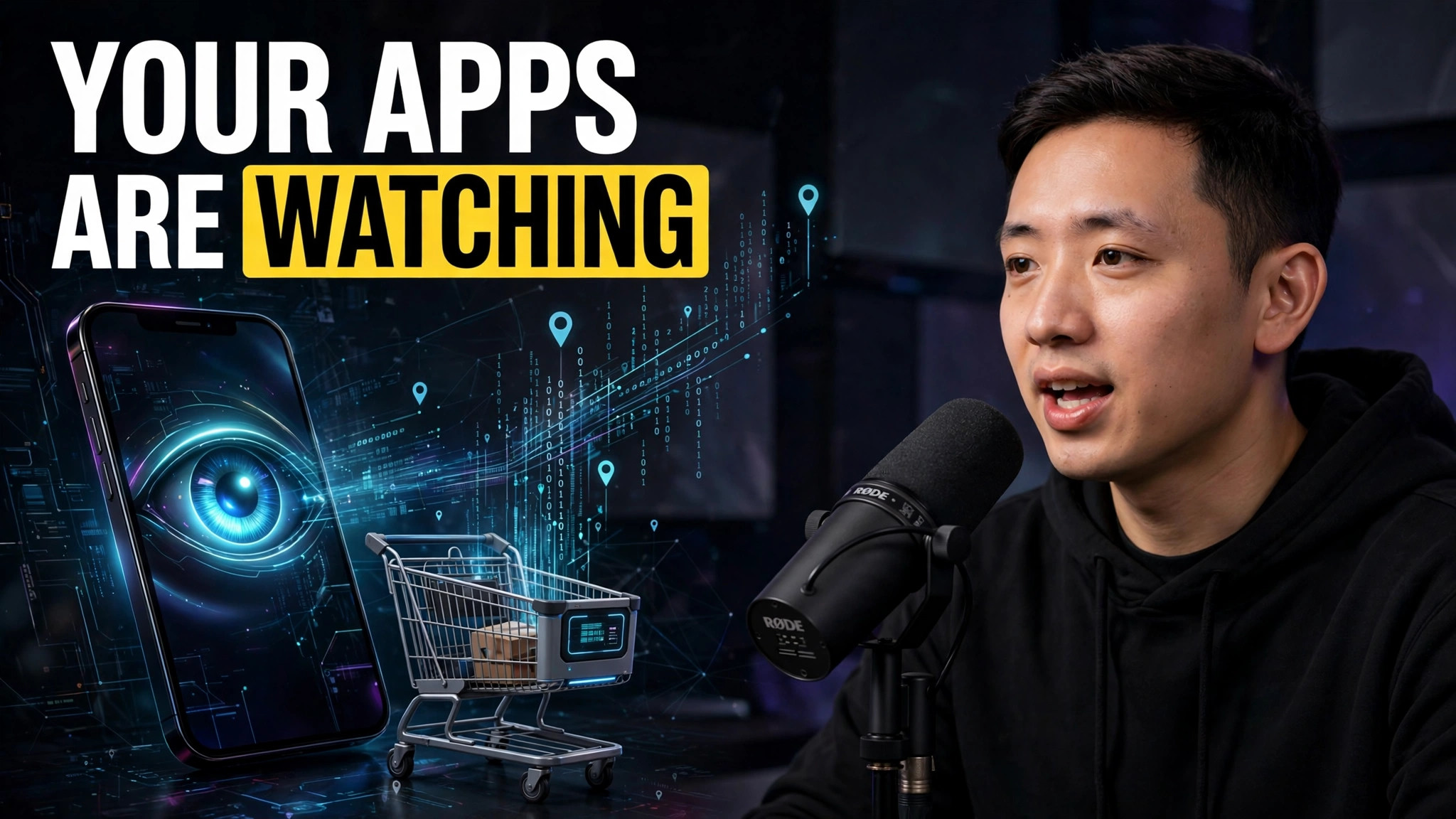
The supermarket cart that suspects you, the dating app that knows your type, and the phone that scores your life — being watched now feels like a feature.
Nobody installed a surveillance system in your life. You downloaded it, one helpful app at a time.
A shopping cart notices what you put in and what you skip past the scanner. A dating app learns who you like, how long you hesitate, and what you say you want versus what you actually choose. Your phone quietly turns your days into scores — steps, sleep, focus, streaks — until you start understanding yourself through the numbers it keeps.
None of this arrives feeling sinister. It arrives feeling convenient. That is exactly why it deserves a closer look.
The cart that thinks you're stealing
Consider the modern supermarket. Self-scanning and smart carts were sold as speed: no queue, no unloading, no waiting.
But the same system that speeds you up also watches you. Miss an item, scan the wrong barcode, move too unusually, and the machine may flag you for a check — accusing you of theft without quite saying the word. Honest shoppers describe the small humiliation of being treated as suspects by a trolley.
This is the pattern to notice. A system designed to reduce loss treats everyone as a risk to be managed. The convenience is real. So is the quiet shift in who is trusted.
Dating, scored and shared
Dating apps make the trade more personal.
To match you with anyone, an app must know a great deal: your location, preferences, habits, photos, and patterns of attraction. Many people now ask whether a date is worth the data — whether finding a partner should require handing a company a detailed map of your desires, movements, and rejections.
The deeper issue is not one app's policy. It is that intimacy itself now runs through systems built to measure and predict. The app does not just introduce you. It studies how you choose.
Living by the score
The same logic has moved inside us.
Writers increasingly describe a person who understands themselves mainly through app scores — sleep quality as a number, health as a ring to close, worth as a dashboard. The metrics can genuinely help. They can also quietly replace self-knowledge: if the watch says you slept badly, you feel tired, whatever your body actually reported.
When scores mediate everything, the score becomes the experience.
| Everyday system | What it gives you | What it quietly takes |
|---|---|---|
| Smart shopping cart | Faster checkout | Being treated as a theft risk |
| Dating app | More potential matches | A detailed record of your desires and habits |
| Health & sleep apps | Clear feedback | Trust in your own body's signals |
| Smart TV & streaming | Personal recommendations | A profile of your moods, hours, and tastes |
| Productivity apps | Streaks and focus scores | The feeling that unscored time is wasted time |
Convenience is a contract
None of this means deleting everything and moving to a cabin. The tools solve real problems, and many people will happily keep the trade.
But a contract you have never read is not much of a contract. A few habits restore some balance: check what an app actually collects before it becomes essential to you, turn off sharing that serves no purpose for you, and be suspicious of any convenience that requires being watched at all times rather than only at the moment of use.
Most of all, keep some unscored territory. A walk you do not track. A date that begins offline. A purchase made the slow way. Not because the old way is purer, but because a life that is fully measured starts to perform for the measurement.
The watching will not stop; it is built into the business model of "free" and "smart." The realistic goal is smaller and stronger: know when you are being observed, decide what the observation is worth, and keep a few corners of your life that no dashboard will ever see.
Topics: Technology, Privacy, Apps, Data, Digital Life
Are you a MacBook user? You can try this clean and calm desktop app customizer — Yoho Desktop App Board