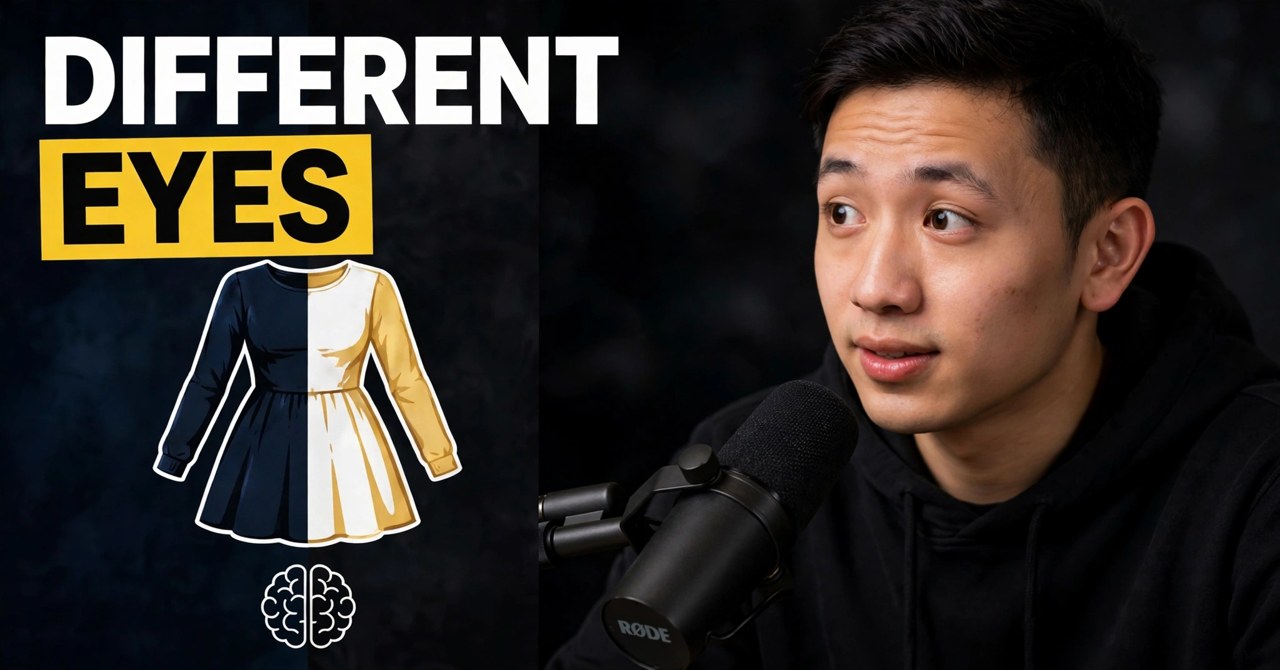
Two honest people can look at exactly the same thing and genuinely see something different — and that says more about how brains work than about who is right.
The dress that broke the internet
A few years ago, a photograph of a dress split the world into two confident camps. Some people saw blue and black. Others saw white and gold. Neither side was joking, lying, or trying to be difficult. Each group was honestly reporting what they saw — and quietly assuming the other must be mistaken.
The photo became famous because it exposed something uncomfortable: perception is not a shared window we all look through. It is a private construction, built by each brain from the same raw light.
Your brain predicts more than it records
We tend to imagine the eyes as cameras and the brain as a screen: light comes in, a picture appears. Real perception works in almost the opposite direction.
Sensory information is slow, noisy, and incomplete, so the brain predicts. Based on past experience, it constantly guesses what is probably out there, then uses incoming signals mainly to correct those guesses. What you experience as "seeing" is the brain's best current model of the world, not a raw recording of it.
That model depends on assumptions learned over a lifetime — and your lifetime is not the same as anyone else's.
Lighting, context, and a lifetime of priors
The dress image was ambiguous because it did not make the lighting clear. If your brain assumed the dress was photographed in shadow, it corrected one way. If it assumed bright, warm light, it corrected the other. Same pixels, different hidden assumption, different colours.
That mechanism runs everywhere:
- A message reads as sarcastic or sincere depending on the tone you expect from its sender.
- A meeting feels hostile or harmless depending on whether you walked in expecting criticism.
- A design looks "clean" to one person and "empty" to another, because each brain fills the blank space with different expectations.
None of this requires dishonesty. It only requires different histories feeding the same predictive system.
A quick comparison
| What we assume | What perception actually does |
|---|---|
| The eyes record the world like a camera | The brain predicts the world and checks its guesses |
| Seeing the same thing means seeing it the same way | The same signal can produce different experiences |
| Disagreement means someone is careless or lying | Disagreement can start before reasoning even begins |
| Confidence proves accuracy | Confidence reflects how settled the model feels |
| More arguing will align our views | Sharing context aligns views better than repeating claims |
What this teaches us about arguments
Most disagreements are treated as battles of logic: if we were both smart and both honest, we would agree. Perception removes that premise. Two people can be smart, honest, and still start from different pictures of the situation. The argument that follows is often two models colliding, not two intellects.
That suggests a different first move. Instead of repeating your conclusion more loudly, compare the inputs. What did each person actually see, hear, or assume at the start? Many arguments shrink surprisingly fast once the hidden assumption — the "lighting condition" — is on the table.
The useful lesson at work and in design
Anyone who builds things for other people lives inside this problem. A designer sees an interface as obvious because their brain supplies a hundred invisible explanations for why each element is there. A first-time user has none of that context, so the same screen genuinely looks different to them. Good design is, in a sense, applied perception science: it reduces the guessing the user's brain has to do.
The same applies to teams. Feedback lands differently depending on the priors people bring into the room. Managing perception is not soft decoration around the real work. Much of the time, it is the real work.
Seeing differently is the default
The dress was never really about a dress. It was a rare, visible proof of an invisible rule: we do not share one world, perfectly copied into every head. We share one world, approximated — usually well, sometimes wildly — by predicting brains.
Once you accept that, disagreement stops feeling like an insult. It becomes information. Someone else's different view is a report from a different model, and sometimes that model noticed the lighting you missed.
Topics: Psychology, Neuroscience, Science, Thinking, Perception
Are you a MacBook user? You can try this clean and calm desktop app customizer — Yoho Desktop App Board