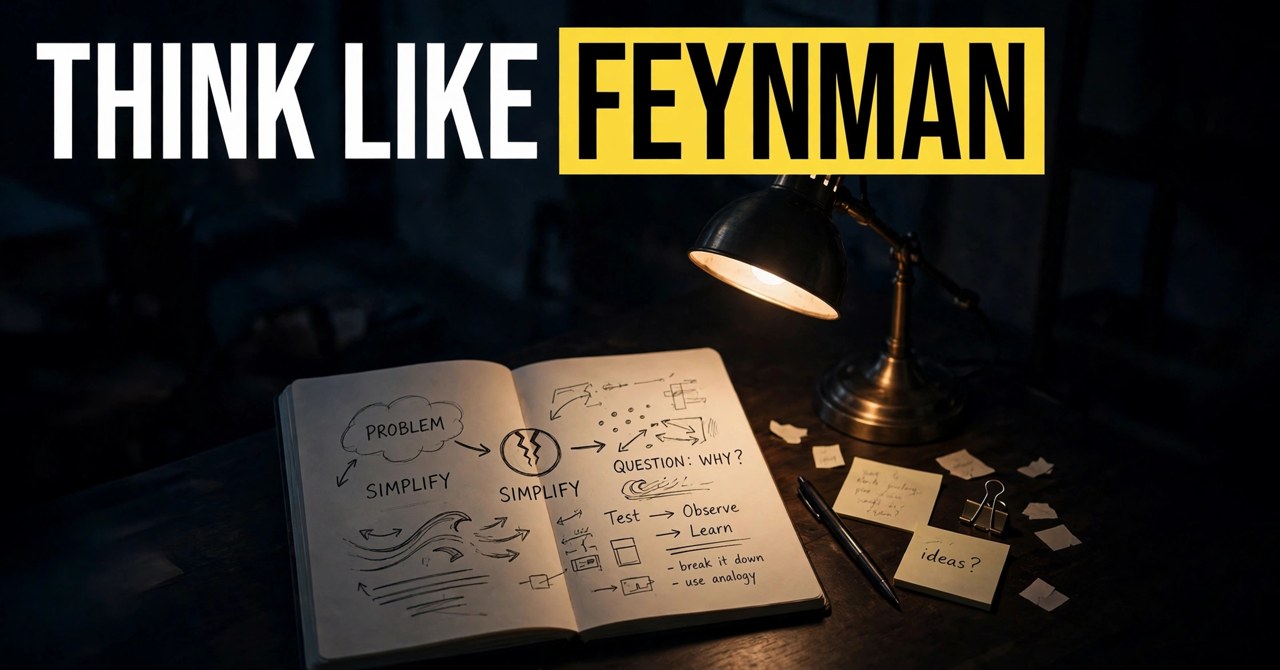
The physicist’s most famous trick was not an equation. It was a refusal to pretend he understood something he could not explain in plain words.
On Medium’s Self-Improvement pages, one title towers over the rest: a piece about Richard Feynman’s thinking habit, with several times the applause of anything around it. A second Feynman piece sits nearby in the “Popular this week” list. Decades after his death, a physicist’s study method is outperforming almost every productivity system on the internet. That is worth understanding, because the habit itself is almost embarrassingly simple.
Feynman won a Nobel Prize, helped build the atomic bomb, and became famous as a teacher. His reputation rests on a talent his colleagues described with envy: he could take an idea that filled a blackboard and state it so a first-year student could follow it. He did not consider that a communication skill. He considered it the test of whether the knowledge was real.
The notebook that starts with a blank page
The method now attached to his name works in four moves. Take a concept you think you understand. Write an explanation of it as if teaching a beginner, in ordinary language, with no jargon to hide behind. Notice exactly where the explanation breaks down — the paragraph where your hand slows, where you reach for a technical word because the simple one will not come. Go back to the source and repair only that gap. Then simplify again.
The breakdown is the point. Most studying hides ignorance under familiarity: you read a chapter, nod along, and mistake recognition for knowledge. The blank page refuses to cooperate with that illusion. It shows you the border of your understanding with embarrassing precision, and it shows you for free, before an exam, a client, or a production bug finds it for you.
| Study habit | What it feels like | What it actually tests |
|---|---|---|
| Re-reading notes | Fluent, reassuring | Recognition, not recall |
| Highlighting | Productive, busy | Almost nothing |
| Watching explanations | Clear, enjoyable | The teacher’s understanding |
| Explaining it yourself | Slow, uncomfortable | Your real gaps |
| Teaching it simply | Exposing | Knowledge you truly own |
Why smart people avoid it
A companion piece on the same pages argues that the smartest people never do one particular thing: they never mistake sounding smart for being right. Feynman reportedly distrusted impressive vocabulary for exactly this reason. Jargon is comfortable because it lets a weak idea pass in a crowd of strong-sounding words. Plain language is a stricter room. In plain language, a confused idea has nowhere to sit down.
This is also why the habit stings. Explaining exposes. Professionals build identities on being the person who understands, and the blank page is a private place where that identity can quietly fail. The people who improve fastest are the ones willing to schedule that failure regularly, in private, where it is cheap — instead of meeting it occasionally, in public, where it is expensive.
Using it in ordinary work
You do not need physics for this. A developer can explain what a system does before building it; the fuzzy paragraph in that explanation is the bug that has not happened yet. A manager can explain a decision in five plain sentences; if the third sentence needs the word “synergy,” the decision is not finished. A student can close the book and teach the chapter to an empty chair.
The practice scales down gracefully. Ten minutes with a notebook beats an hour of re-reading. One paragraph a day, on whatever you are supposed to know, builds a map of your own ignorance that no course syllabus will ever give you — because it is drawn from your actual gaps, not a generic student’s.
The real lesson
Feynman’s habit survives because it is not really about Feynman. It is about the difference between carrying information and owning it. Carried information impresses in conversation and collapses under questions. Owned knowledge survives being simplified, and simplification is the audit.
So pick the thing you are most confident you understand, and explain it on paper to a twelve-year-old. Wherever you stop, start learning. That stopping point — not the applause, not the title, not the years of experience — is the honest edge of what you know. Working right at that edge, a little every day, is the whole trick. It made a genius clearer. It will make anyone clearer.
Topics: Self Improvement, Psychology, Learning, Productivity, Science
Are you a MacBook user? You can try this clean and calm desktop app customizer — Yoho Desktop App Board