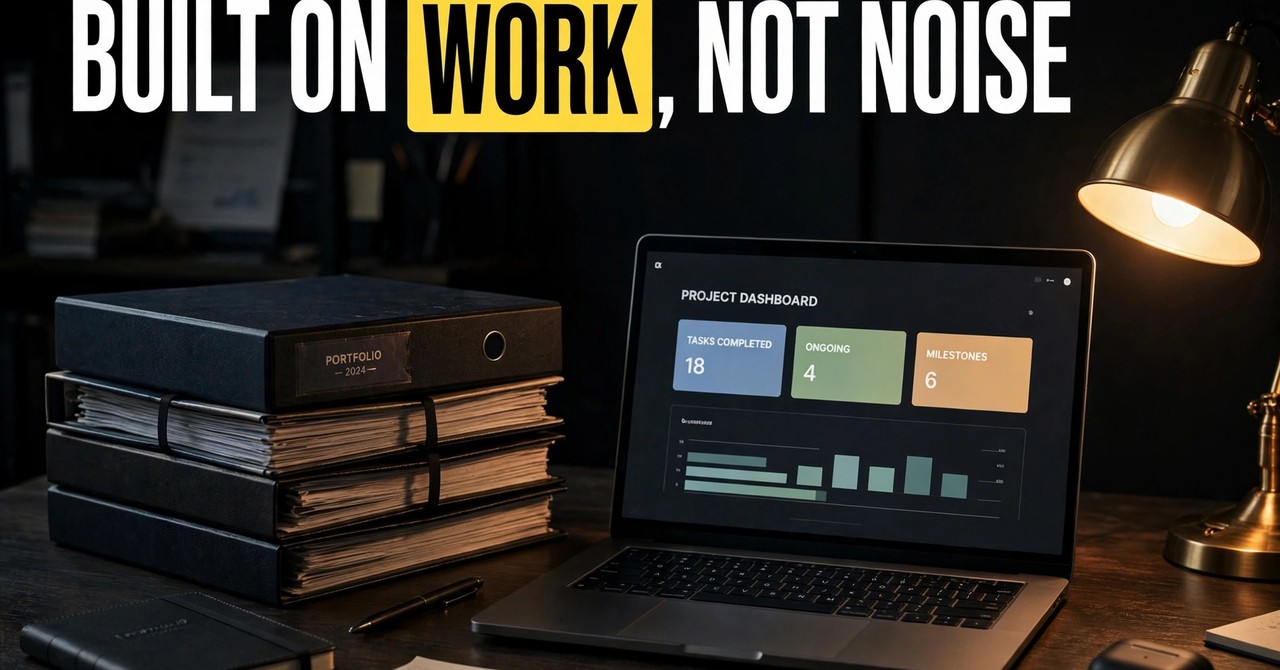
You do not need to become an influencer. You need a body of work that quietly proves, to anyone who looks, what you can actually do.
"Personal brand" has picked up an embarrassing reputation.
For many people the phrase now means performing: daily posts about mindset, photos staged to look like success, opinions borrowed by the hour, and a following counted like a salary. It is no surprise that capable people hear the term and opt out entirely. Being known for loudness feels like the opposite of being good at the work.
But the stories circulating on Medium's Business pages point to a quieter definition, and it keeps resurfacing because it works: a personal brand is simply the evidence trail your work leaves behind. One widely read version of the idea puts it bluntly — you do not need to become an influencer; you need a body of work that shows people what you can do. That is not a branding strategy. That is a filing system for your competence.
The two kinds of reputation
Every professional is building one of two reputations, whether they mean to or not.
The first is rented attention. It depends on constant posting, hot takes, and the algorithm's mood. It can grow fast, and it evaporates the moment the posting stops, because nothing underneath it can be checked. Ask a follower of a rented brand what the person has actually made, fixed, or shipped, and the answer gets vague quickly.
The second reputation is owned evidence. A portfolio of finished projects. Articles that explain how a real problem was solved. Code, designs, reports, talks, or before-and-after results that a stranger can inspect at 2 a.m. without you in the room. This kind grows slowly and compounds, because each piece keeps working while you sleep — and, importantly, while you are not posting at all.
| Rented attention | Owned evidence | |
|---|---|---|
| Built from | Posts, takes, visibility | Finished, inspectable work |
| Speed | Fast up, fast down | Slow up, hard to lose |
| When you stop posting | It fades in weeks | It keeps being found |
| What a client checks | Follower count | The work itself |
| Typical result | Invitations to post more | Invitations to work |
Why evidence beats performance
Opportunities rarely arrive because someone admired your personality online. They arrive when a specific person has a specific problem and goes looking for proof that someone can solve it.
That search is brutally practical. A hiring manager, a founder, or a client with a budget does not scroll for entertainment; they verify. They open the project, read the write-up, check whether the thinking is clear and the result is real. In that moment, one solid case study outperforms a hundred motivational posts, because it answers the only question that matters: can this person do the thing I need done?
There is a second, quieter effect. Making your work visible forces the work itself to improve. Explaining a project in public requires understanding it properly; documenting decisions exposes weak ones. The body of work becomes a training program disguised as marketing.
A realistic way to build one
None of this requires a content calendar or a ring light. It requires a habit of finishing and showing, at whatever pace your real work allows.
Start with inventory: pick three things you have already done that you would happily walk a stranger through. Write each one up plainly — the problem, what you did, what changed. Plain is a feature; clarity reads as competence.
Then attach the habit to work you already do. Solved something annoying? That is a short post. Learned a tool the hard way? That is a tutorial someone is searching for tonight. Shipped a project? Screenshots and three honest paragraphs beat a launch announcement. One piece a month, sustained, produces a dozen verifiable assets a year — more evidence than most loud accounts ever create.
Finally, put it somewhere you control, under your own name, where it can be found by search rather than only by feed. Feeds bury; pages accumulate.
The point of being known
The goal was never fame. It is optionality: the chance to be considered for rooms you are not in, by people you have not met, for work you would genuinely like to do.
That kind of reputation cannot be performed into existence. It can only be built — one finished, visible, verifiable piece of work at a time.
Topics: Business, Personal Branding, Careers, Personal Development, Work
Are you a MacBook user? You can try this clean and calm desktop app customizer — Yoho Desktop App Board