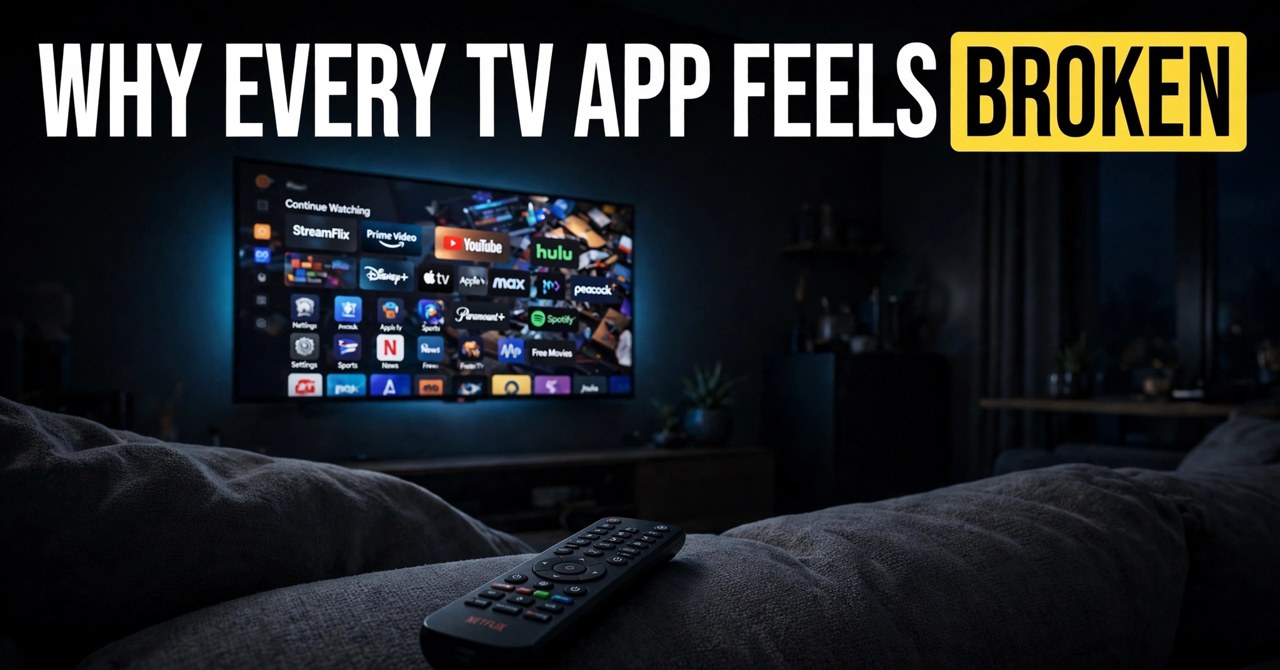
Your phone is a marvel of responsive design. Your television — a bigger, newer, more expensive screen — moves like it is thinking things over.
A small act of rebellion sits in the “Selected by Medium” section of the Technology pages: a writer got so tired of awful smart TV apps that he built his own, and showed readers how to do the same. The piece is not really about one app. It is about a mystery everyone with a television has felt. The most powerful screen in the house is somehow the slowest, buggiest, most advertisement-stuffed computer the family owns.
This is not bad luck. It is incentives, all the way down.
The television is not the product
Start with the business model. For many manufacturers, the profit on a modern TV is thin or negative at the register; the money is made afterward, from the home screen — advertising, promoted rows, and a share of what you subscribe to through it. A device whose screen exists to sell you things will always treat your convenience as a secondary feature. The lag when you press a button is not an engineering failure. It is a queue, and you are not first in it.
The same logic explains the interface. Rows are ordered by who paid for placement, not by what you watched yesterday. Settings bury the options that would reduce ads. Updates arrive to rearrange the storefront, rarely to speed anything up. Your phone’s maker profits when you love the phone. Your TV’s maker profits when you look at the home screen — so the home screen is where the engineering went.
Hardware that ages in dog years
Then there is the silicon. Televisions ship with processors that were modest when new, paired with minimal memory, because the panel is where the budget visibly goes. Phones are replaced every few years; televisions stay on walls for a decade. App developers, meanwhile, build and test for current hardware and move on. The result is a widening gap: apps grow heavier every year while the TV stands still.
| Your phone | Your smart TV | |
|---|---|---|
| Replaced every | 2–4 years | 7–10 years |
| Processor budget | A headline feature | Whatever was left over |
| App updates | Frequent, tested first | Late, sometimes abandoned |
| Home screen goal | Open your app fast | Sell ads and subscriptions |
| Maker profits when | You love the device | You watch the storefront |
Support quietly ends, too. An app that worked at purchase may be frozen, delisted, or degraded five years later — on a television that otherwise works perfectly. The screen outlives its software by years, which is why the humble streaming stick became a mass product: it is an apology you plug in, a replaceable brain for an immortal display.
Why building your own is hard — and telling
The writer who built his own app discovered the other half of the problem: TV platforms are gardens with locked gates. Publishing is restrictive, capabilities are limited, and whole categories of software simply are not permitted. The awfulness is not only neglect; it is also control. A platform that decides which apps may exist will have fewer good ones, and the ones it favors will be the ones that share revenue.
That is the thread connecting every annoyance on the couch. Slow menus, sponsored rows, vanishing apps, remotes with buttons sold to streaming services — each is rational for someone in the chain. Just not for the person holding the remote.
The pragmatic ending
The fix most households eventually find is boring: treat the television as a dumb, beautiful panel, and attach a small, replaceable computer whose maker wants you to be happy — a streaming stick, a console, a mini PC. Let the panel do the one job it is great at, and fire it from the software business it never wanted to do well.
Until manufacturers profit from delight instead of shelf space, the biggest screen in your home will stay its dumbest computer. Not because engineers cannot do better. Because, for the people selling it, “better” was never the metric that paid.
Topics: Technology, Television, Streaming, Gadgets, Software
Are you a MacBook user? You can try this clean and calm desktop app customizer — Yoho Desktop App Board