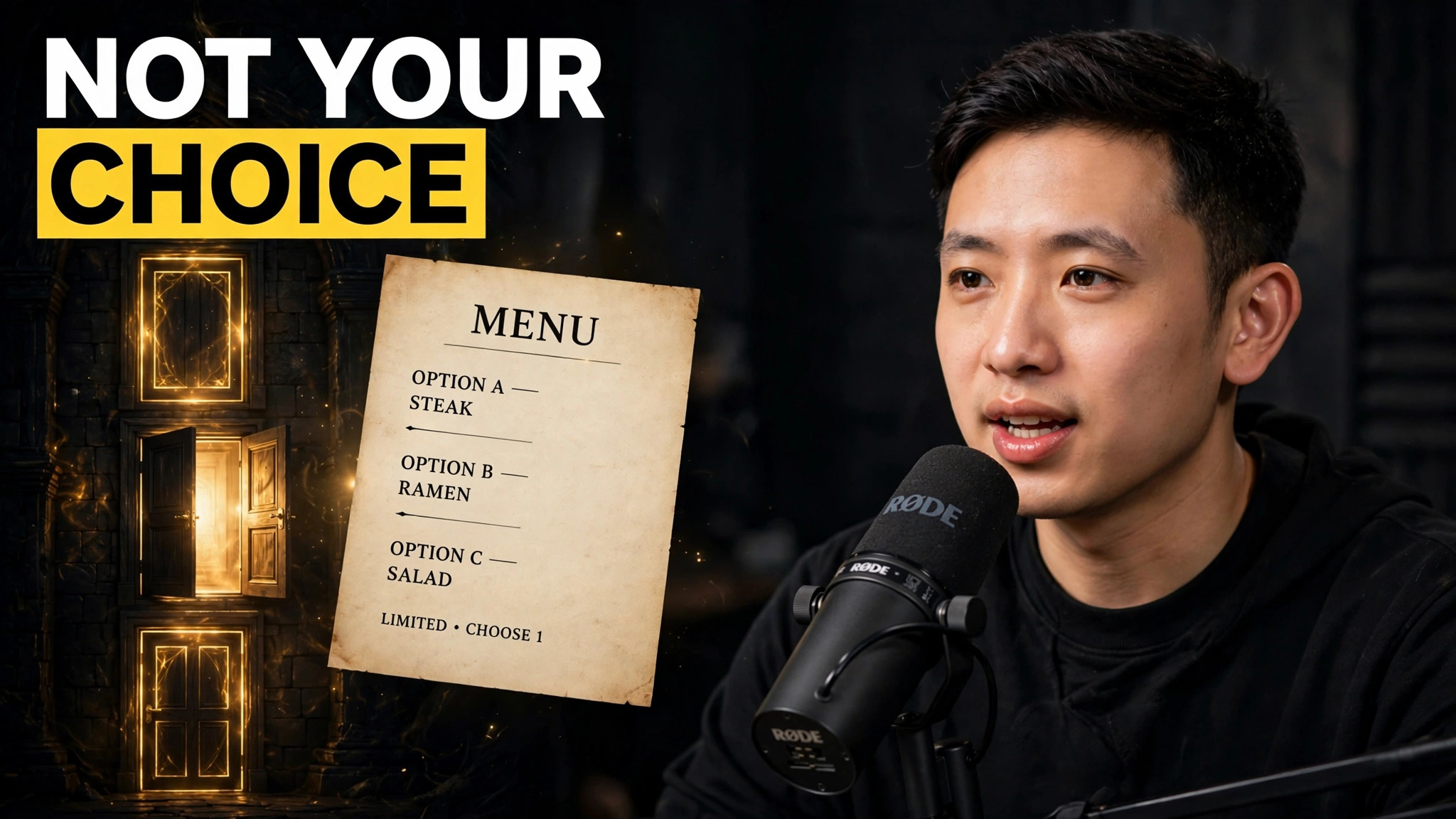
We celebrate freedom of choice, but somebody chose the choices. The options laid in front of us — and the authority behind them — shape our lives more than our decisions do.
We like to believe our lives are made of our decisions.
We chose the job, the city, the partner, the phone, the lunch. Choice feels like the core of freedom, and counting our options feels like measuring how free we are.
But look one step earlier. Before you chose, someone chose what you would choose from — which options appeared, in what order, with which defaults, and which possibilities never made it onto the menu at all. Much of what we call our freedom happens inside a room somebody else furnished.
The options are laid out for us
This is clearest in the debates about women's choices, where the pattern is impossible to unsee once named: the decisions may genuinely be ours, but the options placed in front of us too often are not. Career or family, ambition or likability — when the menu itself is rigged, celebrating the "choice" can become a way of avoiding the people who wrote the menu.
The same structure hides in ordinary life. Your phone's default settings were chosen by a company. Your supermarket's layout was chosen by a retailer. Your employer's career ladder defines which ambitions are even legible. In each case you are free — inside a design.
And behind many menus stands authority, the oldest menu-writer of all. Psychologists describe how readily we obey instructions that arrive wearing the uniform of expertise, tradition, or office — sometimes to the point of acting against our own interests while feeling we had no choice. That feeling is the trick worth examining. Often there was a choice. It was just expensive, and the price was set deliberately.
Skepticism, the old software
Long before behavioral science, the ancient skeptics were working on this problem.
The Pyrrhonists practiced suspending judgment — refusing to swallow the first framing of a question simply because it arrived confidently. Their point was not that nothing is true. It was that the person who controls the framing controls the answer, and a free mind pauses before accepting either.
Even our concepts can be furnished rooms. Some languages hold ideas with no English equivalent — whole ways of seeing that one culture built and another never did. If the words are missing, the option is missing too, however free we feel.
Auditing your menu
You cannot write every menu in your life. But you can audit the important ones.
Ask who benefits from the options as presented. Ask what the default does if you do nothing — defaults are decisions someone made for the passive. Ask what option is conspicuously absent: the sabbatical nobody mentions, the price nobody lists, the "neither" that every either/or hides.
And notice the last moment. Experience designers know that how something ends — the final interaction, the closing impression — disproportionately shapes what we remember and choose next time. Menus are written with endings in mind. Yours should be chosen with your eyes open.
| Place | The menu you were handed | The question that reopens it |
|---|---|---|
| Career | The ladder your employer defines | What would I do if this ladder did not exist? |
| Technology | Defaults set by the maker | Who profits if I never change this setting? |
| Money | The products your bank displays first | What am I not being shown? |
| Relationships | The roles your culture scripts | Which of these expectations did I actually agree to? |
| Beliefs | The framing that arrives with authority | Would I accept this from someone without the title? |
Freedom, one level up
None of this means your choices are fake or that effort is pointless. It means real freedom operates one level higher than we usually aim at.
Choosing well from the menu is a skill. Questioning the menu is a bigger one. The people who change their lives rarely just decide harder among the same options — they move to a different city, a different industry, a different circle, a different set of defaults. They edit the furnishing of the room.
Decide carefully. But now and then, look up from the menu and ask who wrote it, what they left off, and what you would order if you could order anything. That suspicion is not cynicism. It is the beginning of a choice that is actually yours.
Topics: Psychology, Decision Making, Philosophy, Self Improvement, Society
Are you a MacBook user? You can try this clean and calm desktop app customizer — Yoho Desktop App Board