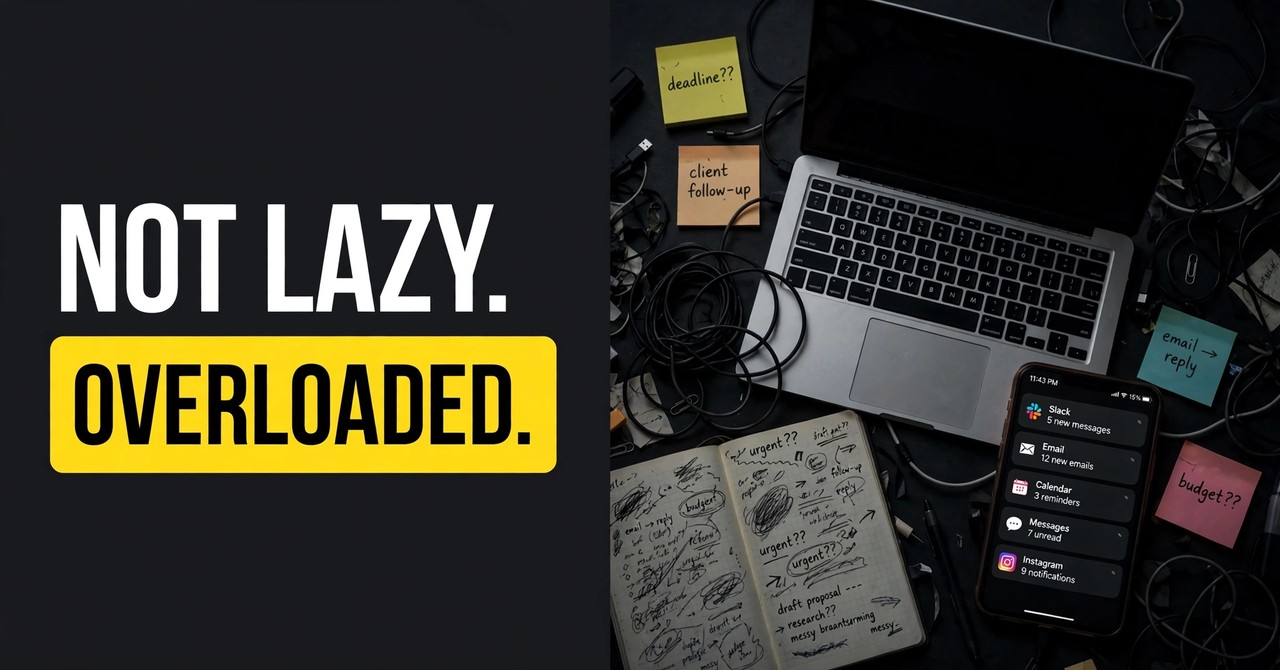
Procrastination, blank staring, and abandoned tasks are rarely a character flaw — they are what a full mind looks like from the outside.
You don’t have a motivation problem.
You have too many things running at once, and a brain that has stopped volunteering for more.
Calling that laziness is easy. It is also wrong — and it makes the real problem worse.
The Label That Backfires
Watch someone call themselves lazy and something predictable happens: they add guilt to the pile.
Now the mind carries shame about the unfinished work on top of the work itself.
Shame is not fuel. It is just one more open tab.
What Overload Actually Looks Like
Laziness means avoiding effort you could comfortably give.
Overload is different. The effort is available, but the system directing it is saturated — too many open loops, pending decisions, and half-finished threads asking for attention at once.
Same symptoms from a distance. Different up close.
| Looks like laziness | What overload is actually doing |
|---|---|
| Putting off a simple email | The email is attached to five unresolved decisions |
| Staring at the screen, doing nothing | The mind is sorting too many priorities to pick one |
| Abandoning a task halfway | Working memory ran out before the task did |
| Irritability over small things | There is no spare capacity left to absorb surprises |
| Scrolling instead of starting | The brain is reaching for the lowest-effort input available |
None of these are cured by trying harder.
They are cured by carrying less.
The Inputs Nobody Counts
Every notification is a tiny request. Every unread badge is a small promise your brain tracks, whether you asked it to or not.
Every “quick question,” half-read article, and postponed decision gets stored in your mind — and storage is not free.
By mid-afternoon, the problem is rarely the size of your to-do list. It is the number of unfinished conversations you are having with yourself.
The Mental Model: A Workspace, Not a Warehouse
The model worth keeping: your mind is a workspace, not a warehouse.
A workspace is small. Brilliant at handling a few things at a time, terrible at storing hundreds.
Every open loop held in your head — the reply you owe, the idea you didn’t write down, the bill you meant to check — is stock piled on the workbench. Eventually there is no room left to work, and the bench looks inactive.
It is not inactive. It is buried.
The fix follows directly: move things off the bench into a system you trust.
Why Discipline Is the Wrong Tool
Discipline assumes the engine is fine and the driver is unwilling.
Under overload, the driver is willing — and every warning light on the dashboard is flashing at once. Pressing the accelerator harder just adds noise.
This is why rest alone often disappoints. A weekend off returns you to the same pile of open loops on Monday, untouched.
Rest pauses the load. Unloading removes parts of it.
One honest note: if exhaustion is constant and does not lift even after real rest, it can have medical causes worth checking with a doctor. What follows is for the ordinary, overloaded kind of tired.
The 10-Minute Overload Audit
Do this today, with a timer, on paper or in a notes app.
- Dump (3 minutes). Write down everything looping in your mind: tasks, worries, decisions, things you owe people. Do not organize. Just get it out.
- Kill the zombies (2 minutes). Cross out anything you will never actually do. A written no closes the loop your brain kept reopening.
- Shrink the list (2 minutes). Circle the three items that matter most this week. Everything else goes on a “later” list you are allowed to ignore.
- Close one loop completely (2 minutes). Pick the smallest circled item and finish it now, or write its exact next step and when you will do it. Vague keeps loops open.
- Cut one input (1 minute). Turn off one notification, badge, or feed. One fewer request per hour is a real load cut.
Ten minutes. No app, no system, no personality transplant.
Run it again when the blank staring returns — that is information, not failure.
Carry Less, Then Judge
The cruel part of the laziness label is that it lands at the exact moment you have the least capacity to argue with it.
Try the other explanation for a week. Treat the fog, the stalling, and the abandoned tabs as a capacity report instead of a character report.
You may find there was never a motivation problem to fix — just a workbench that needed clearing.
When your mind feels full but nothing is getting done, what is the one open loop you know — right now — is taking up the most space on your bench?
Are you a MacBook user? You can try this clean and calm desktop app customizer — Yoho Desktop App Board