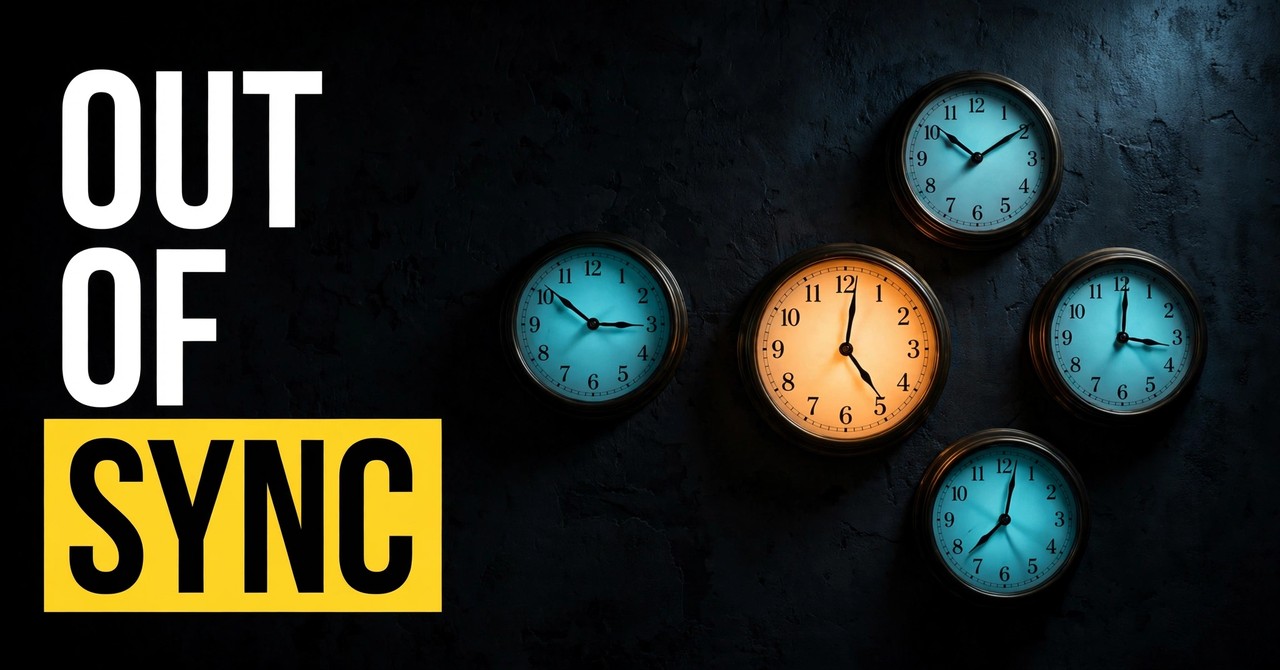
You keep fixing your attitude. The problem might be the clock your life runs on.
Your body clock is not broken.
It is simply set to a different time than the one your calendar obeys.
That gap has a cost. You pay it every single morning.
One Species, Many Clocks
Some people wake up clear-headed before the alarm. Others come alive at 10 p.m., exactly when the world tells them to wind down.
These are chronotypes — natural tendencies toward earlier or later sleep and energy. They sit on a spectrum, and most people land somewhere between the extremes.
Your chronotype is not a preference you picked. It is closer to a setting you were issued, shaped by biology and age.
Social Jet Lag: Travel Without the Trip
Researchers have a name for the mismatch: social jet lag.
Your internal clock says one time. Your work schedule, school run, and social life insist on another. The difference behaves like jet lag — except you never leave home, and it never ends.
Weekdays run on the imposed schedule. Weekends collapse back toward the natural one. Then Monday drags you across the border again.
The Symptoms Look Like Character Flaws
A night owl in a 9-to-5 world looks scattered at 9 a.m. An early bird in a late-night culture looks antisocial by 10 p.m.
Foggy mornings. Wired nights. Caffeine doing the job sleep was supposed to do.
From the outside, it reads as laziness or weak discipline — the same misreading that lands on anyone whose brain works on a different timetable. Look closer, and it is usually timing, not character.
The Mental Model: Energy Has a Schedule
Here is the model worth keeping: energy has a schedule; willpower doesn’t override clocks.
Willpower is a decision. Energy is a tide. You can force yourself through a low hour, but you will do it slower, duller, and at a higher cost.
The people who look effortlessly productive are often just scheduled well — their hardest work sits inside their natural peak, and their meetings sit outside it.
Living In Sync vs Living Out of Sync
| Part of the day | In sync | Out of sync |
|---|---|---|
| Mornings | Wake near your natural time, light-headed within the hour | Alarm drags you out of deep sleep, fog lasts until noon |
| Focus windows | Deep work lands in your peak hours | Deep work is scheduled into your trough |
| Evenings | Energy fades as bedtime approaches | Second wind arrives exactly at bedtime |
| Weekends | Sleep looks like weekday sleep | Two catch-up days undo the week’s rhythm |
The left column is not a personality type. It is what alignment looks like from inside a week.
Find Your Rhythm: A 3-Day Audit
Do not guess your chronotype. Measure it, on three ordinary days — a holiday distorts everything.
- Log your natural wake time. Note when you actually surfaced, alarm or not, and how long the fog took to clear.
- Mark your peaks. Three times a day — morning, afternoon, evening — rate your energy from 1 to 5. Patterns show up fast.
- Mark your trough. Note the hour you would happily nap. That is data, not weakness.
- Find your sleepiness window. Record when your eyelids first get heavy at night, before screens and willpower argue with it.
- Pick ONE anchor to shift. Move one thing toward the pattern you found: morning light within an hour of waking, your hardest task inside your peak, or a bedtime that matches your sleepiness window.
Three days of notes beat a year of self-criticism. You cannot negotiate with a clock you have never read.
You Cannot Move Every Hour. Move the Ones You Own.
Most jobs will not rebuild their schedule around your chronotype. That is reality, not a reason to give up.
But almost everyone owns a few movable pieces: when the deep work happens, when the workout happens, when the screens go dark.
Start with the anchor, not the overhaul. One shifted hour, held consistently, does more than a perfect routine abandoned by Thursday.
One honest note: if sleep problems persist despite a steady rhythm — loud snoring, long insomnia, exhaustion that never lifts — that is worth discussing with a doctor. This piece is about the ordinary out-of-sync kind of tired.
If your job, your family, and your pride all agreed for one week, what time would your day actually start — and what does the gap between that answer and your real alarm clock cost you?
Are you a MacBook user? You can try this clean and calm desktop app customizer — Yoho Desktop App Board