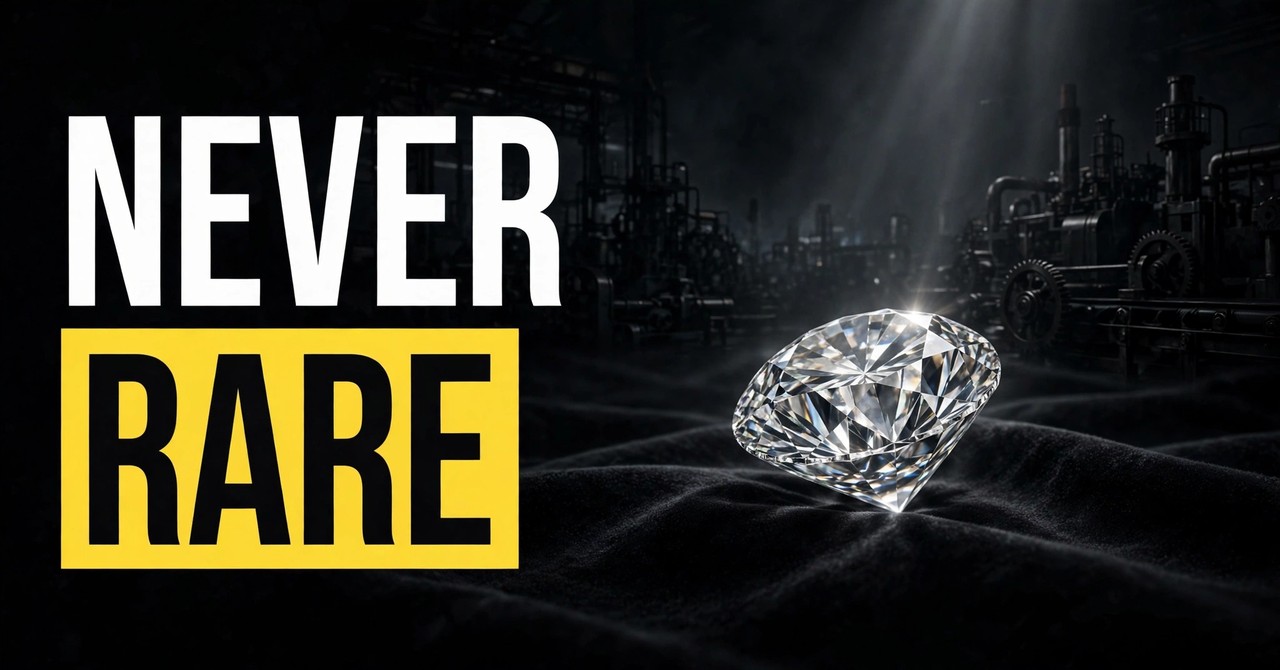
The most valuable stone in your life was never scarce. The story was.
Nobody ever needed a diamond.
The stone on the ring finger was never priced like a material. It was priced like a belief — and beliefs can be manufactured on purpose.
The perfect scam does not sell you a product. It sells you the guilt of not buying it.
The Scarcity Was the Product
Diamonds are carbon — common carbon under pressure, and the Earth made plenty of it. What was rare was never the supply. It was permission to sell it.
For much of the twentieth century, De Beers controlled most of the world’s rough diamond supply. It bought production, stockpiled stones, and released them slowly — a tap opened just enough to keep the garden thirsty.
In 1948, an ad agency working for De Beers produced “A Diamond Is Forever” — and with it, the idea that true love had a minimum size, measured in carats.
The campaign did two jobs at once. It tied the stone to romance so tightly that proposing without one felt like an apology. And it killed the resale market: a diamond that is forever is never sold, so secondhand stones never flooded back to expose what they were actually worth.
Here is the part nobody printed on the box: take a mined diamond to a reseller and you will usually be offered a fraction of what you paid. A truly scarce asset does not behave like that. The markup lived in the distance between the vault and the velvet tray.
Then a Factory Learned the Recipe
Lab-grown diamonds are not imitations like cubic zirconia. They are diamond in the full chemical and physical sense: same carbon lattice, same hardness, same sparkle, indistinguishable without specialized equipment.
For years they were a curiosity, expensive in small batches. Then production scaled — notably in China, where manufacturers treated it as industry, not magic. Presses and growth chambers began turning out stones in volume, cheaper every year.
When supply stops being controlled, the story leaks. Prices for lab-grown stones have fallen dramatically — stones that once sold at a modest discount to mined now often cost a fraction of it.
Identical product — one dug from the ground, one grown last month. The gap is pure narrative, and narratives do not survive a cheaper identical twin.
Mined vs Lab-Grown: What Differs
| Factor | Mined diamond | Lab-grown diamond |
|---|---|---|
| Chemistry | Carbon, diamond lattice | Carbon, diamond lattice — identical |
| How it got here | Dug from the earth | Grown in weeks in a chamber |
| Scarcity | Managed for decades | Scales with factory capacity |
| Price logic | Story: romance, rarity, tradition | Cost of production plus margin |
| Resale value | A fraction of retail | Lower still, and falling |
The Mental Model: Price Is a Story Supply Tells
Here is the model worth keeping: price is a story supply tells.
When supply is hidden or throttled, price floats free of cost and attaches to meaning. When supply becomes visible and abundant, price falls back and reattaches to cost — however romantic the meaning was.
Whenever a huge premium survives next to an identical cheaper option, you are not looking at quality. You are looking at a story with good security.
The Scarcity Check: Run It Before Any Luxury Premium
Copy this. Use it on diamonds, watches, sneakers, handbags — anything sold as rare.
- Can supply actually expand? If someone can make more of this, the scarcity is a policy, not a fact.
- Who controls the tap? If one brand decides how many reach the market, you pay for their discipline.
- What is the resale gap? If it resells for a fraction of retail, the market already told you the real price.
- Is there an identical alternative? Same material, same function, lower price — the difference is the story’s fee.
- Would I want it with the logo removed? If the answer hesitates, you were buying the signal, not the thing.
Five questions. They will not ruin luxury for you — just show you which part of the price is the object, and which part is theatre.
The Stone Survives. The Spell Doesn’t.
None of this makes diamonds ugly, or love cheaper, or a ring meaningless. A symbol can be beautiful and overpriced at the same time.
What the factories broke was the monopoly on the story. A lab-grown stone carries the same fire as a mined one — and every buyer who chooses it votes that the spell mattered less than the sparkle.
So what is the one “rare” thing you paid a premium for that you now suspect was never rare at all?
Are you a MacBook user? You can try this clean and calm desktop app customizer — Yoho Desktop App Board