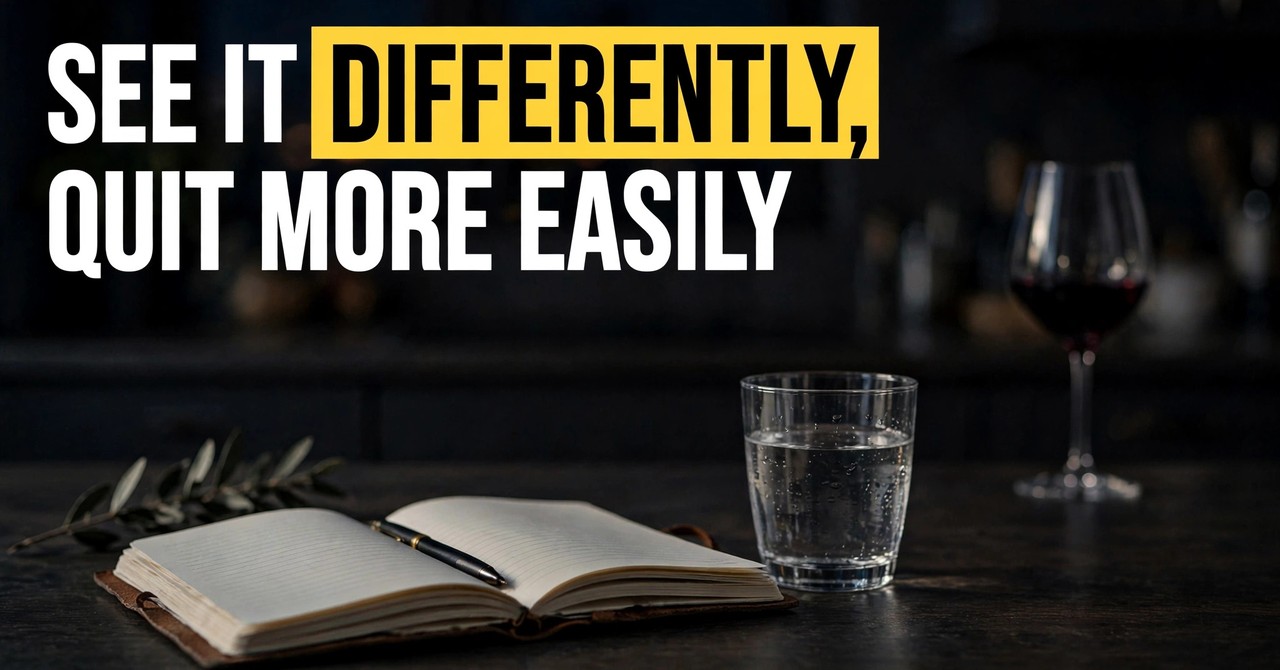
Most people try to quit drinking by fighting the drink. The approaches that quietly work do something stranger first: they change what the drink looks like.
There are two ways to stop doing something you enjoy, and only one of them is sustainable.
The first is resistance. You want the thing, you refuse the thing, you count the days of refusal, and you hold the line through birthdays, bad weeks, and other people's rounds. It can work — but it spends willpower every single day, and willpower is a budget life keeps making withdrawals from.
The second way is re-seeing. Instead of fighting the desire, you change the picture the desire is attached to, until the wanting itself gets quieter. Among the recent stories on Medium's Health pages, one title states the method as plainly as it can be stated: changing the way you see alcohol can make sobriety feel almost effortless. That word — effortless — sounds like marketing. Underneath it is a real psychological mechanism worth taking seriously, whether alcohol is your habit or something else is.
Desire follows the story
Nobody drinks a liquid. They drink what the liquid has been trained to mean.
For years, advertising, film, and ordinary social life have edited alcohol into a highlight reel: the reward after work, the signal that the serious part of the day is over, the shortcut to being funnier, braver, warmer, more honest. The costs — the 3 a.m. anxiety, the flattened next day, the money, the slow drift of health — arrive later, privately, and never get edited into the same reel. The brain, which learns from the version it sees most often, files the drink under "good things" and serves the craving accordingly.
Re-seeing is the deliberate act of re-editing that file. Not with slogans, but with attention: noticing, specifically and repeatedly, what the evening actually delivered versus what it promised. The drink that was supposed to relax you and instead shortened your patience. The "one or two" that quietly set the price of tomorrow morning. Each honest observation loosens the old picture a little. Nothing is being resisted; something is being learned.
| The advertised picture | What attention actually finds |
|---|---|
| It helps me relax | A short calm, then worse sleep and a wired 3 a.m. |
| It makes me more social | Louder, not closer; conversations I half-remember |
| It's my reward | A reward that charges interest the next day |
| I need it to switch off | I never practiced switching off without it |
| Just one won't matter | "Just one" is how the pattern restarts |
Why this works when willpower leaks
Willpower strategies leave the desire fully intact and simply outvote it, daily, forever. That is why they feel like sieges — and why they so often end on an ordinary Tuesday rather than at a dramatic breaking point. Nobody storms the wall; the guard just gets tired.
Changing the picture attacks the other side of the equation. As the promised reward shrinks toward its real size, the craving has less to feed on. People who quit this way often describe the odd experience of not feeling deprived — not because they became stronger, but because the thing they gave up stopped looking like a loss. That is also why the method generalizes: it is the same move whether the habit is smoking, late-night scrolling, or the snack drawer. You do not white-knuckle your way past a thing you no longer romanticize.
Two honest qualifications belong here. First, "effortless" is a direction, not a guarantee: dependence is physical as well as mental, withdrawal can be medically serious, and anyone drinking heavily should treat quitting as a health project — with a doctor, and support — not a mindset experiment. Second, re-seeing takes its own kind of effort at the start: paying attention on purpose, sometimes with a book, a program, a community, or a therapist helping to hold the new picture steady while it is still fragile.
The larger skill
Strip the alcohol out of this story and a general tool remains: before you fight a habit, audit its publicity.
What story has your brain been told about this thing, by whom, and what does a clear-eyed week of actually watching it deliver? Most habits cannot survive honest bookkeeping for long. They live on edited highlights.
Change what the thing looks like, and changing what you do about it stops being a war. It becomes a conclusion.
Topics: Health, Habits, Sobriety, Psychology, Self Improvement
Are you a MacBook user? You can try this clean and calm desktop app customizer — Yoho Desktop App Board