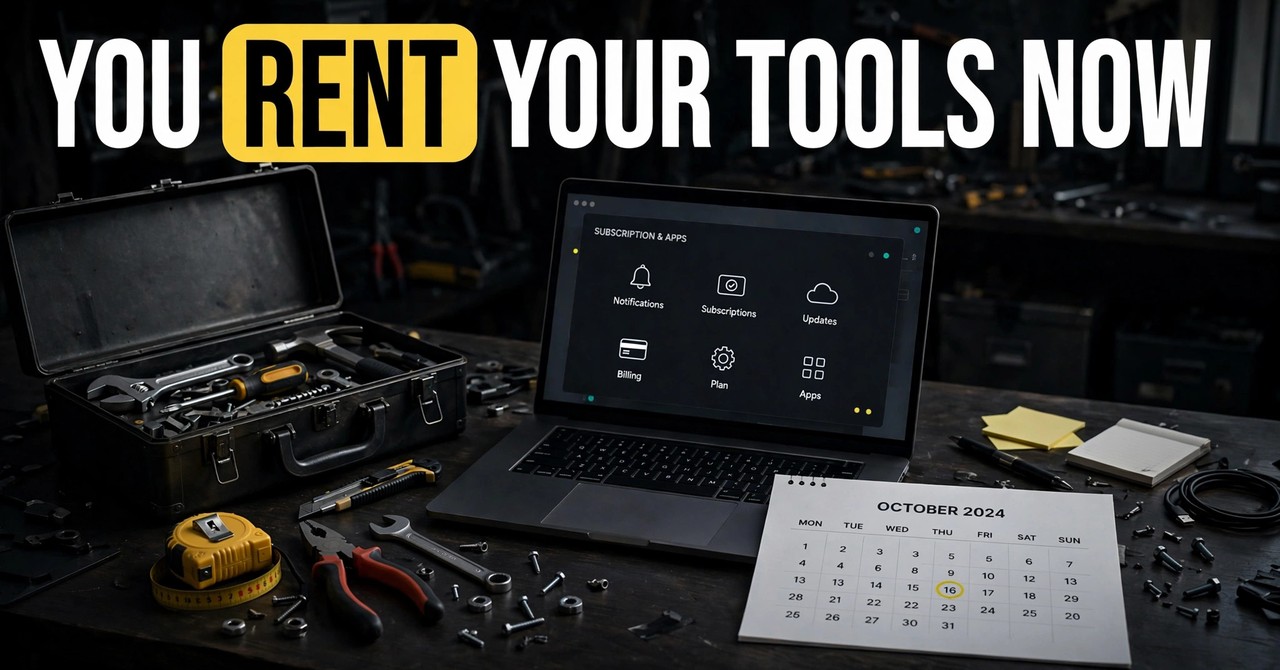
The subscription looked cheaper. It usually does — in month one. Spread it over the five years you will actually use the tool, and the rent tells a different story.
There was a time when buying software felt like buying a hammer.
You paid once, it was yours, and it worked until you decided otherwise. Then, within about a decade, the industry quietly changed the deal: the hammer became a membership. Design tools, office suites, editors, accounting apps, even the drafting software professionals have used for decades — nearly all of it is now rented by the month, forever.
Among the newest stories on Medium's Technology pages is an unusually practical one: a five-year, numbers-shown comparison of what a professional drafting seat actually costs on subscription versus the old perpetual license, across six named products and the free alternatives. It matters beyond drafting, because it does the arithmetic most of us skip — and the arithmetic is the whole argument.
The break-even point nobody prints
Subscription pricing is marketed in its smallest possible unit: per month, per user, billed annually (a phrase that deserves its own suspicion). The honest unit is the working life of the tool — for professional software, realistically five years.
Run the simple version of the math and a pattern appears. A perpetual license, where it still exists, typically costs somewhere between one and two years of the equivalent subscription. After that break-even point, every additional month is pure difference: the subscriber keeps paying rent on a tool the buyer already owns. Across a five-year span, the subscription commonly totals two to three times the purchase price — for access to what is often, in daily function, much the same tool.
| Over five years | Subscription | Perpetual (where offered) |
|---|---|---|
| How you pay | Monthly/annual rent, indefinitely | Once, plus optional upgrades |
| Typical total | Roughly 2–3× the purchase price | The purchase price, then near zero |
| If you stop paying | The tool stops working | Your version keeps working |
| Updates | Continuous, sometimes forced | Your choice, on your schedule |
| Budget shape | Predictable, but permanent | One spike, then silence |
| Files/projects | Hostage to an active account | Yours, on your machine |
What the rent genuinely buys
A fair account has to admit the subscription is not a pure scam; it sells real things. Continuous updates and cloud features are worth money to teams that collaborate live. Renting converts a painful capital purchase into a survivable monthly line, which for a young business protecting cash can be the difference between having the tool and not having it. For software that truly changes every year, renting can be the rational choice.
The problem is not the existence of subscriptions. It is the disappearance of the alternative. When an entire category goes rental-only, the customer loses the break-even point itself — and gains new risks that never appeared on an invoice: prices that rise once your files and habits are locked in, features moved behind higher tiers, tools that stop working the month money gets tight, and "your" workspace that is, in the end, a landlord's property. In security terms the industry calls this vendor lock-in. In household terms it is simpler: you never finish paying for your own tools.
A working rule for your own stack
You probably cannot leave the subscription economy, and you do not need to. You need an audit, because rented tools accumulate like subscriptions always do — quietly, one reasonable monthly charge at a time.
Once a year, list every tool you rent and multiply each by sixty: the five-year price. Then ask three questions of each line. Does this tool change enough each year to justify rent? Would last year's version still do my job — and if so, what am I actually buying monthly? And is there a buy-once or free alternative that covers the honest core of what I use? Most people find their stack sorts itself into three piles: a few tools worth renting forever, a few that should be bought outright where the option survives, and a few embarrassing ones nobody remembers signing up for.
Own what you can. Rent what earns its rent. And never let a monthly price do your thinking for you — five years is the unit your tools live in, whether the pricing page admits it or not.
Topics: Technology, Software, Subscriptions, Money, Productivity
Are you a MacBook user? You can try this clean and calm desktop app customizer — Yoho Desktop App Board